From December 2024 until now, Viet Thang Jean Co., Ltd. has continuously worked overtime to meet orders for the Spring and Summer 2025 collections. With its strategy of accepting small orders and focusing on fashion items, the company already has orders secured until June 2025. Mr. Pham Van Viet, Chairman of the Board of Viet Thang Jean, is confident that this year’s growth will be better than in 2024.
"Textile and garment exports recovered strongly in the last months of 2024. Enterprises have also proactively sourced raw materials and implemented greener production processes to meet the requirements of import markets, including the most demanding ones," said Mr. Viet.
Viet Thang Jean is one of many major textile and garment enterprises that already have stable orders through the second quarter of 2025. In the southern region, companies such as Viet Tien Garment Corporation, Thanh Thanh Cong Textile – Investment – Trading Joint Stock Company, and Dony Garment Co., Ltd. have also received abundant orders since late 2024 and early 2025.
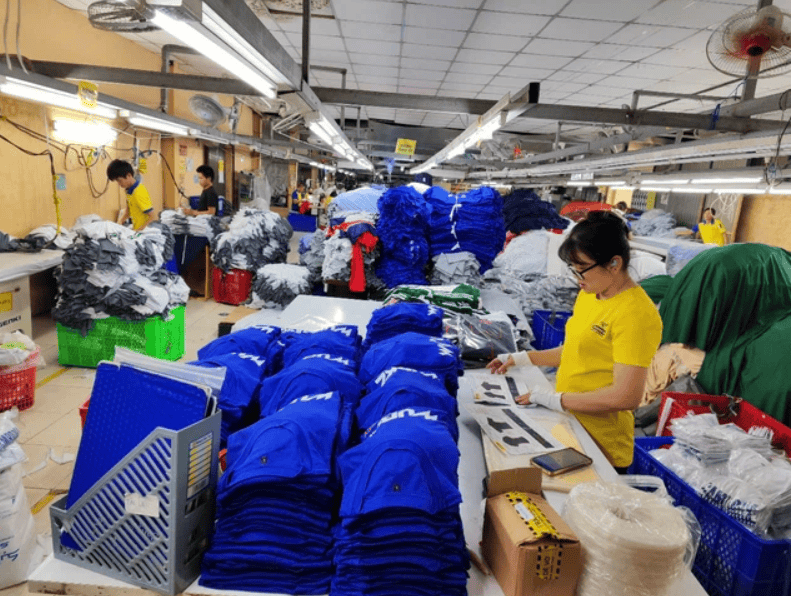
Vietnamese textile and garment products are now exported to more than 100 countries and territories. According to Mr. Vu Duc Giang, Chairman of the Vietnam Textile and Apparel Association (Vitas), besides traditional markets such as the U.S., EU, Japan, China, CPTPP countries (Comprehensive and Progressive Agreement for Trans-Pacific Partnership), and ASEAN countries, Vietnamese textile and garment products have also been expanding to new markets such as Africa and the Middle East. In 2024, Vietnam’s textile and garment industry achieved an export value of approximately USD 44 billion, up about 11% compared to 2023, and rose to second place among the world’s largest textile and garment exporters.
Mr. Giang analyzed that in 2024, some enterprises managed to capture orders shifting from China, Bangladesh, and Myanmar. However, these were basic orders in the low-price segment. Notably, since Q4/2024, Bangladesh’s exports to the U.S. and EU have started to recover, and they are expected to return to normal levels after Q2/2025. At that point, Bangladesh will once again strongly compete with Vietnam.
"In the short term, from now until the end of Q2/2025, the garment industry will continue its recovery momentum from late 2024. Enterprises are also seeing growth signals as major markets such as the U.S., EU, and Japan continue to recover, consumer demand rises, and inventory levels drop sharply," Mr. Giang said.
Overcoming challenges
Although orders have returned and 2025 exports are forecast to benefit from favorable conditions, enterprises remain cautious and are proactively preparing to adapt to difficulties. One major challenge highlighted by enterprises is that unit prices remain low, not increasing compared to 2024, and order stability is still limited. Vietnam continues to rely heavily on imported raw materials from China.
"Partners can change purchasing plans very quickly. Even after orders have been negotiated, if consumer demand slows down for just one to two weeks, brands may ask factories to suspend production. In addition, the trend of splitting orders into smaller lots, requiring faster delivery in shorter times, along with stricter regulations on fabric and yarn origins, forces enterprises to be extremely flexible and adaptive," Mr. Pham Van Viet pointed out.
Mr. Viet revealed that Viet Thang Jean is actively increasing imports of raw materials from India, Pakistan, Indonesia, etc., to replace Chinese materials for orders exported to the U.S. market. However, at his company, materials from China still account for 30%–35%.
Dony Garment Co., Ltd. is one of the few textile and garment enterprises that achieved impressive growth in 2024.
Although not disclosing specific growth figures, Mr. Pham Quang Anh, Director of Dony, shared that export revenue exceeded 20% of the company’s total revenue in 2024.
"In addition to increased purchasing power as market demand recovers, our growth comes from market expansion. Our growth has come from both the domestic market and traditional markets such as the U.S. and the Middle East, as well as newly explored markets such as Cambodia, Thailand, Malaysia, Singapore, Russia, etc. Recently, we also signed a contract with a customer in Africa. We have been producing uniforms for many years, specializing in custom-made products, so our processes, teams, methods, and pricing are all strong competitive advantages," Mr. Quang Anh said.
Mr. Tran Nhu Tung, Chairman of Thanh Cong Textile – Investment – Trading Joint Stock Company, pointed out the dual pressures of green transition and digital transformation in production. Enterprises are forced to transform and improve their competitiveness to avoid being eliminated, while the investment costs for transformation (upgrading machinery, technology, management systems, etc.) are significant, order stability is low, and selling prices are not increasing.
According to Mr. Vu Duc Giang, Chairman of Vitas, under the textile and footwear development strategy, from now to 2030, the industry will gradually shift from fast development to sustainable development. From 2031 to 2035, the textile and garment industry will develop sustainably and effectively, following a circular economy model, completing the domestic value chain, and participating at higher-value positions in the global supply chain.